


Learning a new language goes far beyond mastering its linguistic features. At its core, language is shaped by the culture, history, and everyday life of the people who speak it. At Tieng Viet Oi, our intensive Vietnamese courses emphasize immersive cultural experiences both inside and outside the classroom. If you happen to pass by our Hanoi Head Office one day, don’t be surprised to see our teachers and students out in the neighborhood, chatting with and interviewing local residents as part of their learning journey.
One of our standout students in recent months is Josh Blaustein. Over the course of eight months, Josh pursued intensive Vietnamese-language studies at the University of Languages and International Studies in Hanoi and later at Tieng Viet Oi’s Hanoi Head Office. Not only has he demonstrated an impressive command of Vietnamese, but he has also shown a genuine passion for exploring Vietnamese culture in all its richness. Join us as we look back at Josh’s memorable experiences and reflections from his time studying Vietnamese with us.
“My name is Josh Blaustein, and I studied Vietnamese in Hanoi for eight months on a full scholarship. At first, I studied at the University of Languages and International Studies, but from January to May this year, I had the opportunity to study at Tieng Viet Oi. I’m American, and I’ll be starting a JD program (Doctor of Jurisprudence) in the United States soon.”
What inspired you to start learning Vietnamese? Before coming to Vietnam, what were your impressions of the country and the Vietnamese language?
Before coming to Vietnam for the first time, I really didn’t know anything about the country. There weren’t any Vietnamese people in my hometown, and I didn’t even try phở for the first time until last summer! The only thing I had heard was that Vietnamese is a very difficult foreign language to learn, mainly because the pronunciation is so complex. For example, Vietnamese has six tones, while English doesn’t have any tones at all. At the time, the only parts of Vietnamese culture I knew about were phở, conical hats, and the country’s history.
What led you to choose Tieng Viet Oi for your intensive Vietnamese studies?
Previously, I lived with a host family, and one of the family members recommended that I study at TVO. I often relied on that person’s advice, so I decided to enroll there.
My scholarship required me to study at least 18 hours per week, and the program met that requirement. Before I started studying at TVO, I didn’t really have any expectations because I still knew very little about the Vietnamese language center system in Hanoi.
Could you tell us about your learning experience at Tieng Viet Oi? What were some of the highlights, challenges, and most meaningful areas of growth during your time here?
I studied 19 hours per week. During the program, I had the opportunity to learn with three teachers—Ms. Le Linh, Ms. Tuyet, and Ms. Hanh. Honestly, I didn’t encounter any difficulties while studying Vietnamese at TVO—everything went smoothly. I especially enjoyed the Multiple Teacher Class (MTC) because it gave me the chance to learn from a very diverse group of teachers in terms of age, personality, and hometown. I’m very grateful to have had that experience.
I think that when I first started studying at TVO, I was already at a fairly high level in Vietnamese. At that point, I understood the grammar and already had a pretty solid vocabulary. On the other hand, communicating in Vietnamese was still very difficult because my listening comprehension wasn’t very strong. Spending 19 hours a week speaking and listening to Vietnamese helped me improve my communication skills tremendously. Now, I feel much more comfortable carrying on conversations than I did before.
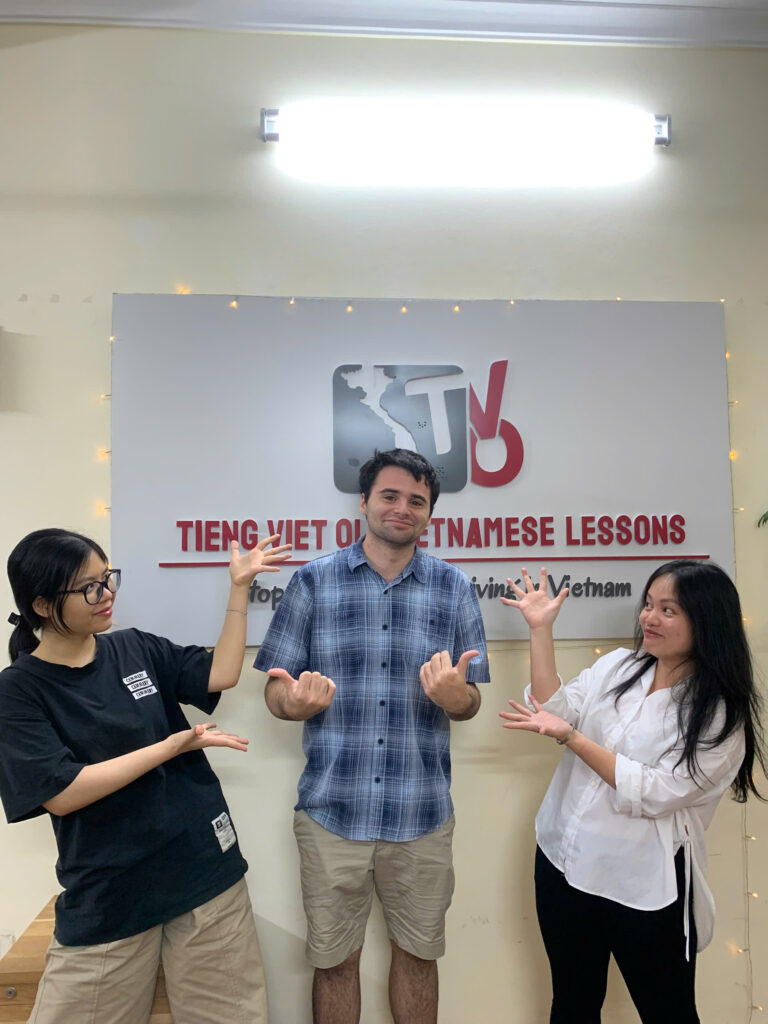
I really like TVO because being there never felt like being at school. Everyone is so friendly and genuinely wants to support and help as much as possible. On top of that, everyone takes a real interest in the students and wants every student to feel included. I’ve attended three birthday parties at TVO, visited the hometowns and met the families of two teachers, and returned to TVO countless times just to catch up with everyone. The teachers at TVO even gave me gifts like tea, Chocopie, and cakes!
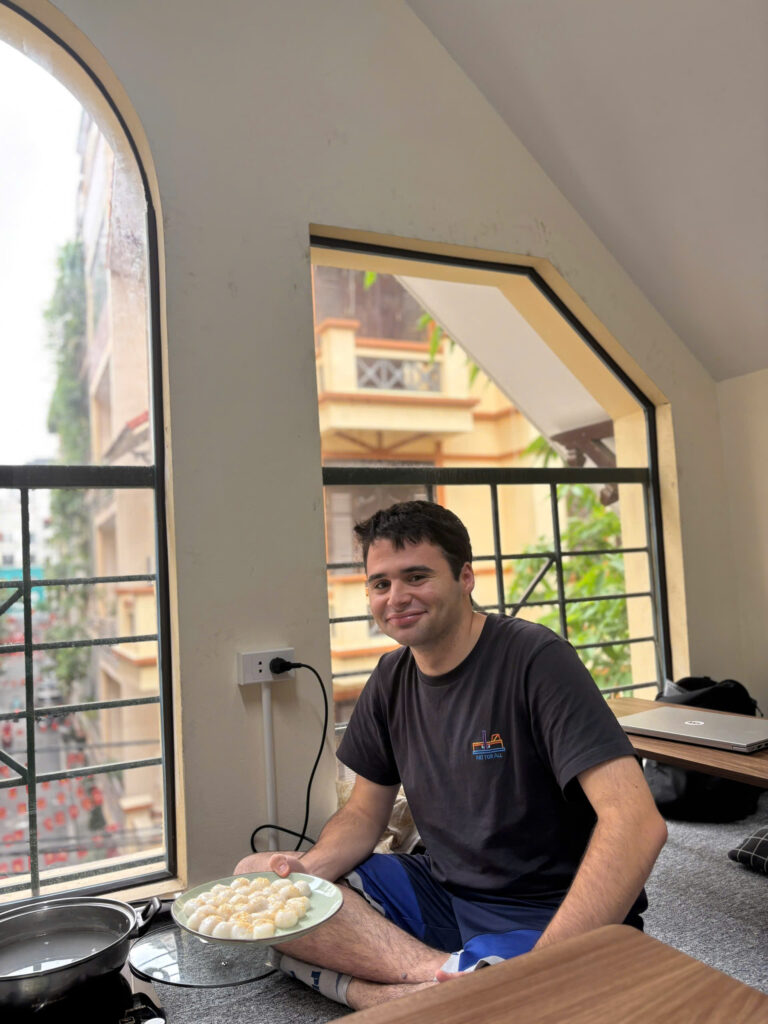
Beyond the classroom, what cultural experiences or activities did you take part in while living in Hanoi? How did your Vietnamese studies enhance your ability to engage with and appreciate Vietnamese culture?
I only attended one TVO event outside the office, but it was a lot of fun. Aside from that event, I had many opportunities to explore Vietnamese culture. For example, this year was the first time I had the chance to celebrate Tet in Vietnam, and I spent Tet in Lao Cai.
While I was in Lao Cai, I met only one person during those two weeks who could speak English. I had to rely entirely on my Vietnamese communication skills. Since I had already been studying at TVO for more than a month by then, I felt fairly confident communicating in Vietnamese. I’m very grateful to TVO because, honestly, without TVO, I don’t know how I would have made it through those two weeks in Lao Cai. The reason I was able to fully enjoy Tet there was because of what I learned at TVO.
After completing the intensive course, what improvements have you noticed in your Vietnamese language skills and overall confidence communicating in Vietnamese?
After studying at TVO for five months, I returned home immediately afterward. I feel comfortable writing, reading, listening to, and speaking Vietnamese. I believe that the ability to speak Vietnamese is absolutely essential for anyone who wants to live in Vietnam long-term.
This ability is important not only because it brings many practical benefits to foreigners living in Vietnam, but also because it is the clearest way to show respect and appreciation for the Vietnamese people. As the saying goes, “Nhập gia tùy tục”, or “When in Rome, do as the Romans do.” If someone wants to live in Vietnam, they should never expect other people to speak English for them.
Looking back on your time at Tieng Viet Oi, what are some of your favorite memories?
Of course, my favorite memories are the experiences I had outside the office—especially the two trips to my teachers’ hometowns. Two of my three teachers invited me to visit their hometowns, experience rural life, and meet their relatives (I’m still eagerly waiting for an invitation from Ms. Le Linh, even though she says I’ll “never be invited”). The trips to Nam Dinh, Cam Khe, and Den Hung are memories I’ll never forget. And if I could say one more thing to the teachers at TVO, it would simply be “thank you” once again—for inviting me to your hometowns and for supporting me so much.
Would you recommend an intensive course to someone who is just beginning their Vietnamese learning journey? Why or why not?
Of course, I would recommend learning Vietnamese at TVO.
If I could give one piece of advice to someone just starting to learn Vietnamese, it would be to be patient. When you first begin learning Vietnamese, it can seem overwhelmingly difficult, and many people give up after just a week or two. However, Vietnamese is a very unique foreign language because, in my experience, it actually gets easier and easier over time.
Since pronunciation is the most difficult aspect of Vietnamese, students usually focus on that first. But once you’ve mastered the pronunciation, Vietnamese grammar is actually very easy and quite similar to English in many ways. As a result, if a student studies patiently and manages to get through those first few weeks, I’m confident that they will succeed.
After leaving Vietnam, what do you think you will miss the most?
Of all the things I’ll miss when I return home, what I’ll miss most is the attitude of the Vietnamese people. I’ll miss their hospitality, their kindness and care for others, and above all, the strong sense of community that is such an important part of Vietnamese culture.
I’ll miss the streets of Hanoi, always bustling with activity, the night market in the Old Quarter, and, most importantly, the opportunities to leave the big cities behind and visit the countryside, where I could interact with ordinary people. The countryside has a special atmosphere that is almost impossible to put into words.
As a famous Vietnamese saying goes:
“I return to bathe in my village pond; whether its water is clear or muddy, my home pond is still dearer. The love of one’s homeland remains steadfast and enduring, while the fields, the countryside breeze, and the haystacks wait in quiet expectation.”
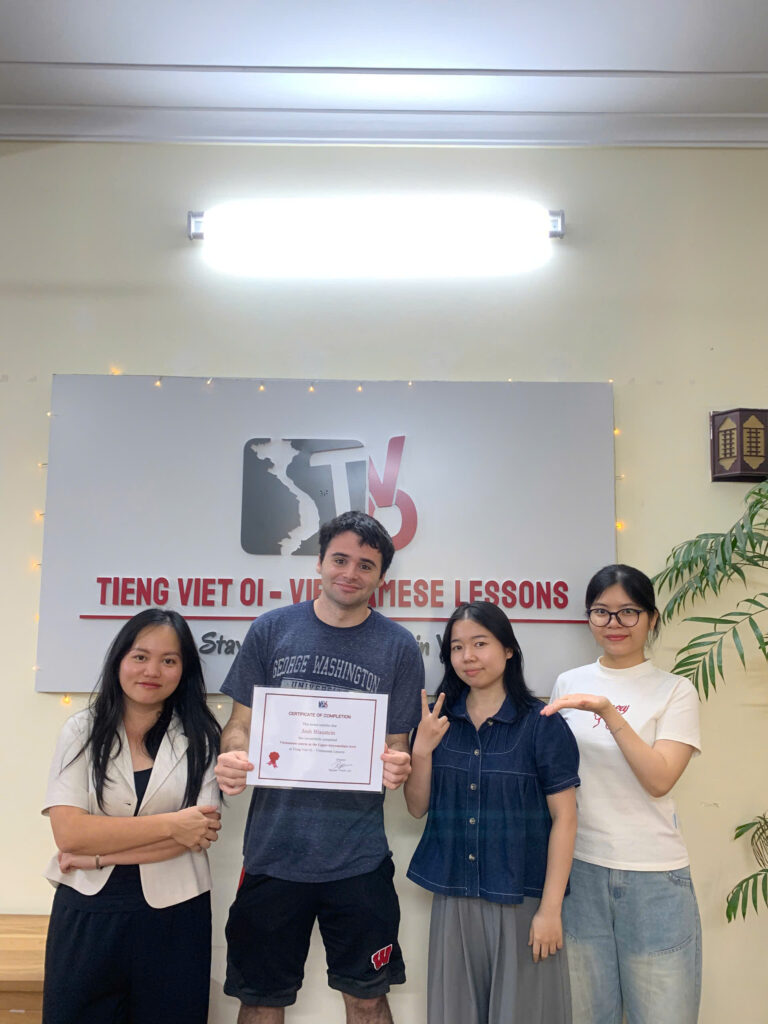
A heartfelt thank-you to Josh for taking the time to share his story with us. Everyone at Tieng Viet Oi is incredibly grateful to have had such a dedicated, curious, and kind student as part of our community. We wish you all the best in your future endeavors and hope your Vietnamese learning journey continues for many years to come.
Thinking of joining our intensive, personalized course soon? Sign up here, and we’ll reach out ASAP!
Still making a decision? Explore our YouTube channel for free lesson content here.